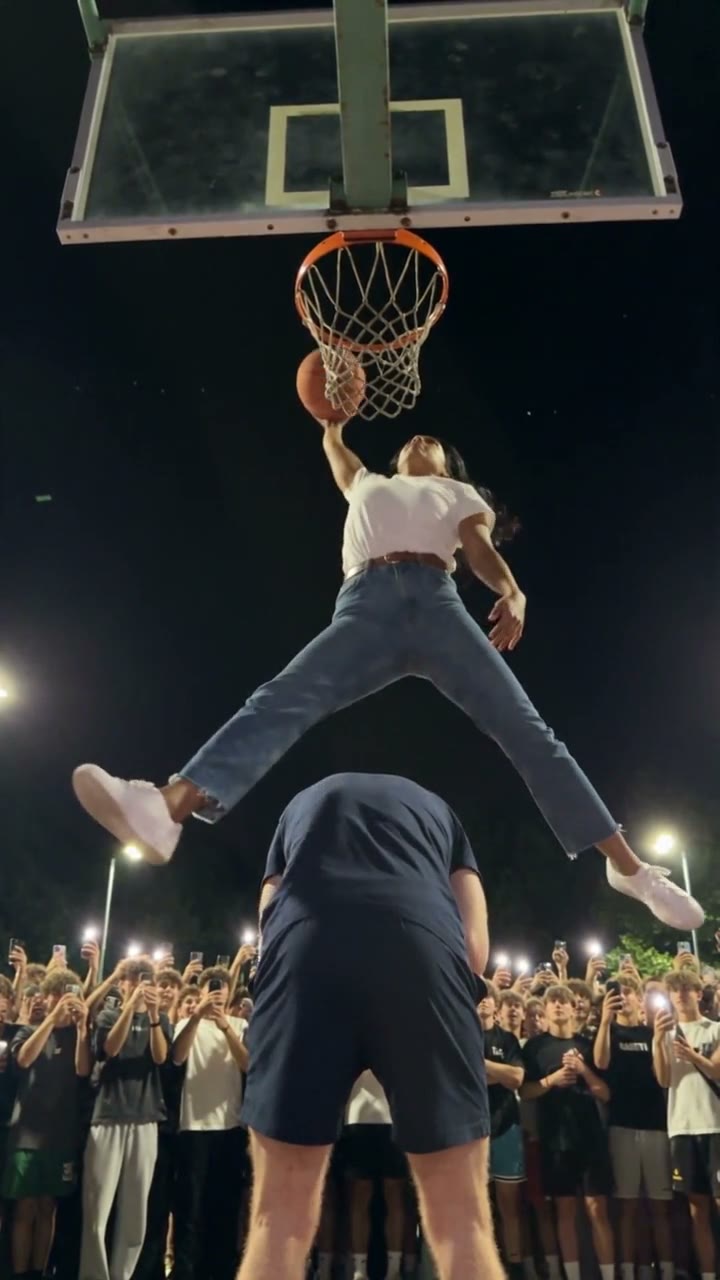
The play from crossover to final taunt
The setup needs the relationship between attacker, defender and hoop to be clear. A crossover creates the first change of direction, then the exaggerated leap takes the attacker over the opponent before the dunk. Slow motion makes the unlikely height of the jump the central joke. The shoulder brush and shrug close the scene without a rude hand signal.
When reviewing, follow the basketball as well as the face. The ball should remain connected to the play, the hoop should stay in a sensible position, and the bodies should separate after the jump. An impressive opening court shot is not enough if the landing or identity falls apart. This is a stylized generated highlight, so exact movement and small details can differ from a reference.
Why the familiar trend name has a clean ending
The rude gesture explains a common search name, but it is not necessary to keep the scene’s boastful humor. A shoulder brush says the player considers the play effortless; the stare and shrug let the visual joke land without asking the model to perform the original hand signal.
That choice also makes the intended result clearer before you upload a friend. You are commissioning a fictional basketball flex, not an abusive message or a real humiliation clip. Still, a clean gesture does not replace consent. Ask the other person before casting them as the defender, and consider whether they will enjoy being tagged. Avoid captions that make viewers believe the scene records an actual confrontation.
Duo and Solo use the same price, different casts
Duo is for a specific pair. The first image establishes the dunker and the second establishes the opponent. Swapping those roles before submission changes who gets the highlight. Solo keeps your uploaded person as the main subject and lets the recipe invent the other player.
Both current choices cost 152 credits and list a 12-second 720p vertical output. The second Duo upload is part of that configured version rather than an extra-priced photo service. Choose based on the cast you want, not an assumption that Solo will finish faster. Generation time can vary, so follow the task status instead of planning around a fixed completion promise.
Checking ball, hands and identities
A dunk combines several difficult visual relationships: a moving ball, gripping hands, a rim, two bodies and a landing. Start with clear photographs whose limbs are not hidden behind another person or furniture. If a face is tiny or heavily filtered, the model has less reliable information when the camera angle changes.
Watch the crossover and leap slowly before sharing. Look for a ball appearing in the wrong hand, the defender changing identity, or the attacker merging into the hoop. A better source may help an unclear cast, but it cannot guarantee a physically exact simulation. Do not use the clip as a technique demonstration, and never attempt the generated leap because an AI video makes it look possible.