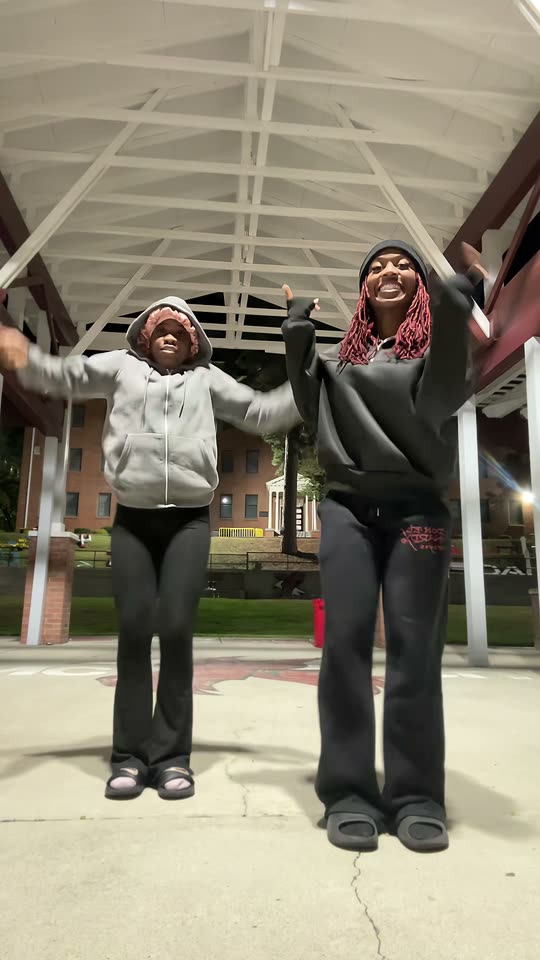
Following the routine’s main accents
The dance is built from a sequence of readable shapes rather than constant fast footwork. Wide raised arms create the opening accent; a sway leads into the lifted knee and slap. In Duo, the exchange of positions is the turning point. The later hands-to-head pose and lean toward the knees give it a clear finish.
Those movements help explain what to check in an AI result. The knee should belong to the right body, the crossing dancers should stay distinct, and the faces should remain recognizable after the bend. The reference supplies the movement idea, but generated fingers, clothing folds and exact timing may differ. The aim is a convincing personal take on the routine, not a guaranteed duplicate of a particular post.
What changes between Solo and Duo
Choose Solo when you want one identity and the setting in your photograph as the starting point. Motion control applies a solo take of the routine to that subject. This makes an open standing photograph more useful than a tight selfie, even though both contain a face.
Duo is for the friendship version, with one uploaded person in each starting position. Both are animated into a shared scene and exchange places as part of the routine. It costs more because it is a different configured generation, not because the second picture is a separate add-on. If the cast order matters, confirm the slot labels before starting rather than trying to repair it with a caption afterward.
Choosing the right sound and wording
The dance sound is associated with Baby On The Track’s beat built around the sitcom-related spoken intro. It should not be confused with unrelated tracks that happen to have Puerto Rican Mami in their titles. Smew’s configured choices use their reference soundtrack, joined to the generated picture before the final file is saved.
That arrangement does not establish rights to the sample or music. Check the rules for your intended use, and choose authorized platform audio where appropriate. A caption can introduce the pair or explain why you picked Solo without repeating the dialogue or lyrics. Labels such as duo dance or Puerto Rican Mami help readers recognize the format; they do not make the animation an official performance from the show.
Keeping two people distinct through the crossover
Identity is easiest to lose when two animated subjects overlap. Give each upload a clear face and a body outline that does not merge with furniture, another person or the edge of the image. If one picture is a tiny face in a distant group and the other is a sharp portrait, the inputs give the model uneven information.
Watch the crossover and the final bend before accepting the clip for a public post. Look for the left and right identities staying consistent, stable arms, and legs that reconnect naturally after the knee gesture. A sharper or more complete source can help, but no upload guarantees perfect choreography. If the source is unsuitable, change the photograph rather than repeatedly submitting the same ambiguous crop.