Can Can dance: Choose a solo routine, a trio line or a pet interpretation.

Bring the high-kick can-can format to your own portrait, a group of three or your pet. The selected version determines both the number of uploads and the generation approach.

The original Can Can Dance reel by @morph_verseOriginal reel
  • 1–3 photos depending on version
  • 10 seconds
  • Price shown before generating

No prompt to write: Add your photos and tap once

Create your own

Ready in a few minutes · From 52 credits

The familiar can-can tune turns an ordinary dancer into a burst of high knees, kicks and flapping arms. Social versions often trade cabaret polish for everyday clothes and a grin, making the contrast part of the joke. A solo hop, a linked kick line and a costumed pet can all share that playful energy without being the same scene.

Smew offers Solo, Trio and Pet. Solo transfers movement to a standing adult photo, Trio casts three consenting adults, and Pet gives one animal the theatrical interpretation. All current choices run for 10 seconds in vertical 9:16 at 720p, with the configured reference music saved into the finished video.

Example

Preview the Can Can dance format

Visual references explain the format. Generated details and timing can vary.

Solo visual reference
A format reference, not a Smew customer result.
Use this reference
Step by step

Make your Can Can Dance video

Choose a version, add the required photos and check the displayed credits before generating.

  1. Choose the performer setup

    Solo needs a standing full-body adult photo. Trio uses three separate adult images in role order: middle, left, then right. Pet takes one full-body animal photo. Compare the references because each choice changes more than the number of subjects.

  2. Review the engine and credits

    Solo uses Kling 3.0 Motion Control at 52 credits. Trio and Pet use Seedance 2.5 at 228 and 152 credits respectively. Every current choice is 10 seconds, 720p and vertical 9:16, with the motion recipe already included.

  3. Watch feet, faces and the shared finish

    Dashboard shows processing; Library holds the completed file after the soundtrack is joined. Inspect kicks near frame edges, Trio identity order or Pet paws and costume. A clean opening frame does not establish that every fast movement will stay coherent.

Choose a photo that keeps the subject recognizable

For Solo, show one adult standing from head to feet with room for a wider kick and raised arms. The source photo guides the setting, clothing and appearance. A cropped or seated image does not provide the same useful body information. Face the camera in clear light with no sunglasses or mask.

Trio takes three separate photos, one adult each. Photo one is the middle dancer, photo two the left and photo three the right. Clear faces matter, while the scene supplies its coordinated costume styling. Do not upload a group image into one slot expecting three identities to be assigned automatically.

For Pet, include one cat or dog with the whole body visible and eyes open. The recipe supplies the theatrical dress and dance scene, so there is no need to dress or pose the animal. Use your own photo or the owner's permission, and use consenting adults for the human choices.

Where the format comes from

The can-can's broader history belongs to Paris dance halls and stage entertainment, with high kicks and coordinated lines becoming part of its visual identity. The best-known musical association is the Infernal Galop from Offenbach's 1858 operetta Orpheus in the Underworld. That composition's age should not be confused with ownership of a particular modern recording.

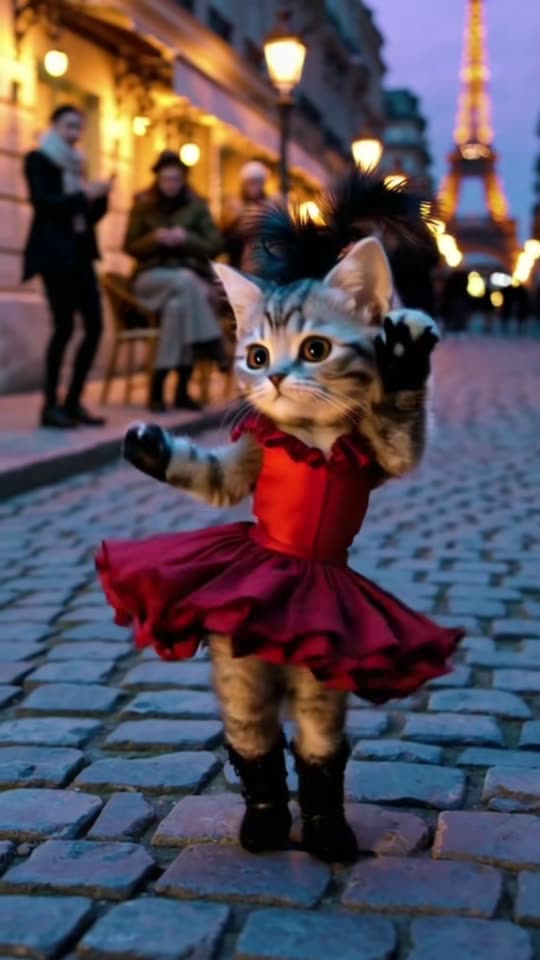
Social-video interpretations often simplify the spectacle into playful hops and comic arms. The linked @happykelli trio and @thisisnotaprilatall solo illustrate different versions of that idea. An AI kitten example adds the costume-and-animal joke rather than demonstrating a real pet's performance.

Smew's choices respond to those distinct formats. They do not teach a full stage routine or imply an official Moulin Rouge connection. The source references are credited examples, not customer results or evidence that one social post defines every can-can dance. Changing audience totals are unnecessary for understanding the cast and output choices.

  1. Offenbach's operetta provides the historical context for the familiar tune.

  2. A living-room trio shows the comic linked-line interpretation. Credited example

  3. A solo cover demonstrates hops and exaggerated arm movements. Credited example

  4. An AI kitten version adds a theatrical costume and Paris-like setting. Credited example

  5. Photo-driven templates offer separate solo, group and pet interpretations.

Copy and paste

The recipe behind the result

The template applies its configured instructions. No prompt writing is required for this flow.

Solo

1 photo: you, head to feetKling 3.0 Motion Control10 s · 720p · 9:1652 credits
Video prompt

Render a photorealistic 9:16 sequence using [Video 1] as the visual guide. The single dancer is [Image 1]. Preserve the uploaded location, hair, top and shoes; use long loose trousers rather than a skirt or the reference performer’s outfit. Follow the reference camera, scene continuity, relative action timing and cuts unless the scene instructions below explicitly change the setting. Transfer the comic can-can sequence from [Video 1]: high knee hops, brisk kicks, leaning accents and the remaining arm gestures in the same rhythm. Keep the whole figure readable while the feet leave and return to a consistent floor. The raised legs must remain attached to the correct hips, with no duplicated shoes or body stretching. Keep the face recognizable during every tilt and return, and finish with the same visual cadence as the reference. Keep each uploaded identity distinguishable through every view: consistent face structure, complexion, hair, age and build. Never transfer a target face onto another body. Retain the selected outfit rules rather than reverting to the reference performer. Change only the assigned performers, leaving other roles and props coherent. The soundtrack is handled separately: match visible mouth shapes and rhythmic gestures to the reference performance without generating a recording, sung words or dialogue from it. Add no unrelated people, extra body parts, captions, signatures or watermarks.

1432 characters

Trio

3 photos: you, in the middle + friend 2, on the left + friend 3, on the rightSeedance 2.510 s · 720p · 9:16228 credits
Video prompt

Render a photorealistic 9:16 sequence using [Video 1] as the visual guide. [Image 1] is the centre performer, [Image 2] the left performer and [Image 3] the right performer. Keep those three identities fixed, using their own appearance and selected clothes. Follow the reference camera, scene continuity, relative action timing and cuts unless the scene instructions below explicitly change the setting. Follow the reference’s three-person kick line, preserving the formation, high knees, leg extensions, linked timing, expressions and camera cuts. Keep each kick inside its own body silhouette rather than joining legs across performers. Maintain the centre-left-right assignment through turns and bends; do not add a fourth dancer or let background faces acquire an uploaded identity. Retain the same opening formation and coordinated final beat. Keep each uploaded identity distinguishable through every view: consistent face structure, complexion, hair, age and build. Never transfer a target face onto another body. Retain the selected outfit rules rather than reverting to the reference performer. Change only the assigned performers, leaving other roles and props coherent. The soundtrack is handled separately: match visible mouth shapes and rhythmic gestures to the reference performance without generating a recording, sung words or dialogue from it. Add no unrelated people, extra body parts, captions, signatures or watermarks.

1442 characters

Pet

1 photo: your pet, whole bodySeedance 2.510 s · 720p · 9:16152 credits
Video prompt

Render a photorealistic 9:16 sequence using [Video 1] as the visual guide. The full central animal dancer is the pet in [Image 1], never a human with the animal’s head. Follow the reference camera, scene continuity, relative action timing and cuts unless the scene instructions below explicitly change the setting. Reproduce the supplied pet routine as upright furry-animal acting: springy hind-leg hops, alternating kicks and front-paw gestures with the original timing. Retain the source setting, props and camera while replacing the entire pet body, including the tail. Keep natural body volume and a recognizable animal expression during each kick, then return to the reference ending pose. Do not turn a raised paw into a human hand. Preserve the uploaded animals as whole animals: their species, muzzle, ears, coat pattern, size and tail must remain recognizable. Front limbs end in furry paws, never human fingers; keep one head and four limbs per animal, even when the acting is upright. Change only the assigned performers, leaving other roles and props coherent. The soundtrack is handled separately: match visible mouth shapes and rhythmic gestures to the reference performance without generating a recording, sung words or dialogue from it. Add no unrelated people, extra body parts, captions, signatures or watermarks.

1334 characters

Models, duration and credit cost

You pay in credits. The Generate button shows this price before you spend anything. These are the options on this page.

OptionModelWhat you getCredits
SoloKling 3.0 Motion Control10 s · 720p · 9:1652
TrioSeedance 2.510 s · 720p · 9:16228
PetSeedance 2.510 s · 720p · 9:16152

One-time packs and plans are on the pricing page. A failed video gives its credits back.

Solo hops, a trio line and a costumed pet

Solo follows a comic full-body routine with high knees, front and side kicks, little hops and exaggerated arms. It uses movement transfer, so your photo's standing subject and setting guide the visual result. A clear floor and space around the legs matter more than a dramatic backdrop.

Trio is a coordinated group scene. Claps and hip sways establish the three dancers before the linked kick-line idea becomes the focus. Photo order places the first adult in the middle, with the other two on the left and right. The scene's bright coordinated clothing is a different visual approach from preserving one person's source outfit.

Pet uses the theatrical red-dress interpretation, including a headpiece and boot-like styling in a Paris-street atmosphere. The animal remains the identity supplied by the photo, while the impossible costume and movement are generated. No real pet stunt is needed.

All three choices create a 10-second video. Solo is 52 credits, Trio 228 and Pet 152. They share 720p, vertical 9:16 and configured reference music, but differ in engine, cast and scene. Choose the version for the joke you want, not simply by the can-can name.

From a stage association to an everyday dance joke

The historical can-can suggests energy, a line of performers and emphatic kicks. A social version becomes funny when that theatrical language appears in a living room, on an ordinary person in casual clothes or on a clearly artificial pet character. The contrast does much of the work before a caption is added.

The familiar tune is commonly identified as Offenbach's Infernal Galop. A modern sound recording still has its own rights, even when the underlying composition is old. Smew joins the configured reference soundtrack after picture generation and saves the final audiovisual file; access to that file is not a universal license for commercial publishing.

This template keeps the intended mood playful. It is not an adult stage-performance recreation or a way to demonstrate actual flexibility. A generated high kick does not mean the subject performed one. If you want to learn the dance physically, use an appropriate teaching source and safe practice rather than treating the output as instruction.

An original caption can explain an unlikely rehearsal, a friendship kick line or a pet's imagined debut. Keep the AI disclosure and the subjects' permission. Descriptive can-can and dance tags can identify the reference without promising reach or claiming an official association with a venue or performer.

When a kick or costume stops looking convincing

Start with Solo framing. If a leg leaves the image or the movement looks timid, inspect whether the source includes both feet and enough space for the wider motions. Arms pressed against the torso or a seated pose can make full-body movement transfer less readable. A sharp standing source is more useful than repeated attempts with an unsuitable crop.

For Trio, check all three faces across claps and kicks. The intended order is middle, left, right, but generated motion can blend faces or inherit an accessory from the reference. Separate clear portraits and distinguishable hair or clothing cues help assignment. Watch linked arms and crossing legs rather than only the front-facing opening.

Pet adds another challenge: a costume must move around an animal body. Inspect paws, muzzle, fur markings and the dress through the turn. Human-like hands or a disappearing garment can change the joke. A whole-body animal photo in good light provides stronger guidance than a close face crop.

Every new generation can differ, so another paid take is not a guaranteed repair. Review the finished video with its soundtrack before sharing, and keep the impossible animal performance or unperformed human choreography clearly labeled as AI.

FAQ

Can Can Dance questions

What is the can can dance trend on TikTok?

It is the playful take on the familiar high-kick dance: hops, raised knees and exaggerated arms, often in casual settings. Solo, linked-line and animal interpretations can differ. Smew offers three distinct recipes rather than one universal can-can clip, with references that explain each version's tone.

How do I make a can can dance AI video?

Choose Solo, Trio or Pet and supply the required photos. Solo takes one standing adult; Trio takes three separate consenting adults; Pet takes one animal. Check the selected credits before starting. The current choices are all 10 seconds, with the saved result available in Library after processing.

What makes the can can dance funny?

The dance carries a grand theatrical association, while the performer and location can be deliberately ordinary. A casual outfit, exaggerated arms or an unlikely pet costume creates the contrast. The scene works best when identities and timing remain readable, so review the movement rather than relying on a caption alone.

Can my cat or dog do the can-can?

Select Pet and add one clear whole-body image. The recipe supplies the theatrical dress, styling and dance atmosphere. You do not need to put clothes on the real animal or make it stand. Check paws, coat markings and costume continuity in the generated take before sharing it as AI imagery.

What is the can can song?

The familiar association is the Infernal Galop from Offenbach's Orpheus in the Underworld. This recipe uses its configured reference recording, added after picture generation. The underlying composition's age does not remove rights in every recording. Check publishing terms for your destination, especially for commercial uses.

Is the can-can a sexy dance?

The intended tone here is comic and playful, with human and pet recipes following the supplied references. It is not a promise of a particular adult stage show or a body-focused performance. Use consenting adult photos for the human choices and review the generated framing and clothing before publishing.

Do I need to know the dance?

No. The saved motion or scene recipe supplies the routine, while the photo supplies identity. Solo uses motion control in the source setting; Trio and Pet use their configured scenes. A tutorial is useful for physically learning a dance, but that is a different goal from making this imagined performance.

Which hashtags fit a can can dance video?

A few descriptive can-can, dance and AI-context tags can tell viewers what they are seeing. Write a personal setup about the unlikely dancer or kick line instead of copying a source caption or claiming a real performance. Keep the AI disclosure and do not treat a hashtag as a reach guarantee.

How long is the video and what format is it?

All current Smew choices are 10 seconds, vertical 9:16 and 720p, with the configured soundtrack saved into the final MP4. Solo costs 52 credits, Trio 228 and Pet 152. Choose the cast and scene that fit your planned post. Review the selected row on Create before starting.

Try Can Can Dance with your photos

Choose your version, review its output and credits, then start your own take.

No watermark. A failed video gives its credits back. Secure checkout by Stripe.