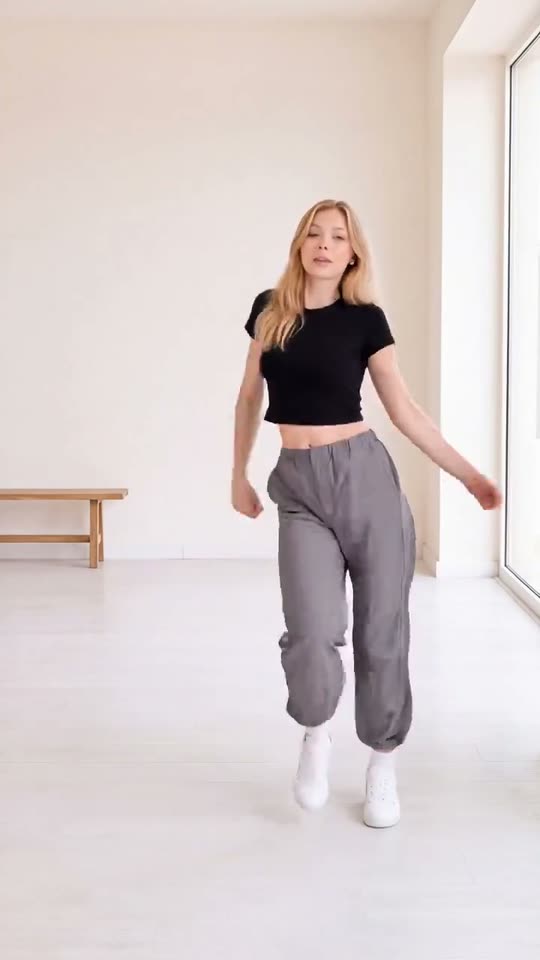
The solo phrase and the late-arriving partner
You follows a short fixed-view routine. Small toe bounces establish the rhythm before open-hand shrugs and chest gestures. Hip sways and knee pops create changes in level, while a wider stance keeps the movement readable. A hand near the hair and a playful lean supply the finishing attitude.
Because this choice transfers motion to a standing photo subject, the frame needs enough room for those gestures. A close portrait cannot supply the same visible footwork as a full-body image. The intended result retains the uploaded person's clothes and location cues while using the reference motion, not the reference dancer's entire appearance.
Duo is a separate 10-second scene. The first adult performs alone, reaches out and brings the second person in. Shared movement and a close finish turn it into a friendship or partner joke. The entrance and role order are its important checkpoints. The solo's 13-second duration and motion-control workflow should not be assumed to apply to the paired take.
The song question and the AI-video question are different
A post claiming that a track is AI-made is not the same as documentation from its credited producers. The source names nissi and 25Hzz, while the linked discussion shows how uncertainty became part of the social trend. We do not present that speculation as a confirmed production fact or decide ownership from a caption.
The dance can still be a genuine human choreography reference. A person learning and performing it, an AI character following it and a remix of the song are three separate kinds of work. Understanding the distinction helps you credit the routine without describing every video using the sound as AI.
Smew's role is clear: it generates a video performance from photos. You uses motion control, and Duo uses a scene recipe with two identities. Neither workflow proves anything about the original track's vocals. Label your finished take as AI-made and credit the song and choreography context on their own terms.
Choose the version for the story you want
Pick You when the whole routine and your source setting are the attraction. A room, corridor or safe outdoor space can supply a recognizable personal stage, provided the standing body and floor remain visible. This choice is 52 credits, 13 seconds and uses Kling 3.0 Motion Control.
Choose Duo when the second person's arrival is the point. Use two consenting adult photos in role order. The first character starts, the second is brought in, and the scene uses its own bright-room composition. That choice is 152 credits for 10 seconds with Seedance 2.5. Both outputs are vertical 9:16 at 720p, ready for a portrait post.
A tutorial serves another purpose: teaching the choreography to someone who will physically perform it. This workflow does not require that practice, but it also does not demonstrate that you learned the dance. It creates a fictional take whose roles, timing and fine details can vary.
Sharing the soundtrack and personal twist
The configured reference soundtrack is joined after video generation and saved in the completed file. Library preview and download therefore use the same finished audiovisual result. That convenience does not establish a universal license for the track, especially for a business account, sponsored placement or advertisement.
Give your caption a personal setup: a familiar place becoming a dance floor, or a reluctant friend being drawn into the last part of a routine. Avoid copying lyrics or using a false claim about the song's production as a hook. An AI disclosure makes the origin of your own performance clear.
Use descriptive song, dance and Jersey-club context where helpful. Tags can identify the format without proving that a clip will reach a particular audience. If you choose a platform's licensed audio instead in a separate editor, check its terms and review the timing rather than assuming any sound with the same title is identical.
Where movement transfer can look unnatural
A cropped foot, narrow frame or seated pose can make the solo motion appear stiff. Start with a standing image that leaves space for hands and knee lifts. Arms pressed tightly against the body can be difficult to separate during motion. Clear lighting and visible fingers offer more useful information than a heavily filtered portrait.
Reference-like hair or clothes may appear if your photo leaves those details ambiguous. A full-body source with a recognizable outfit helps keep the motion reference and appearance reference distinct. Fast hand movement can still blur, so watch the ending hair gesture and the transitions around the face.
For Duo, check whether the right identity enters and whether hands remain coherent at contact. Two separate, sharp adult photos are preferable to a group crop. A new take may differ, but repeated generation is not a guaranteed repair; first improve an unsuitable image or choose the version whose framing fits your goal.