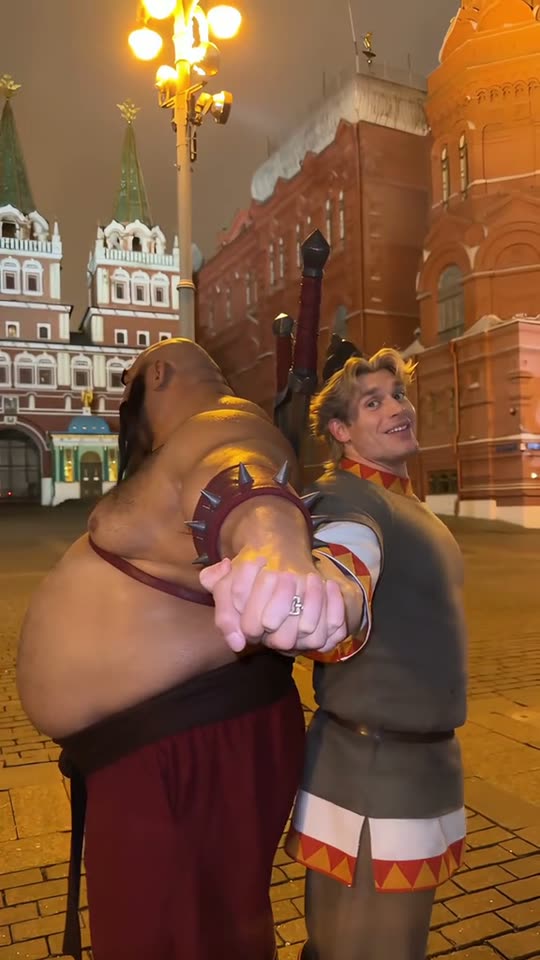
How the back-to-back performance unfolds
The pose is established before either person performs: backs together, outside hands joined toward the lens, attention turned away. One character looks over a shoulder to deliver a short part, then the other answers. The camera-facing smiles and raised eyebrows make the duet read as playful rather than a confrontation between warriors.
The broad sequence matters more than claiming exact timing for every syllable. Watch whether both identities remain stable during the shoulder turns and whether the joined hands stay plausible. The soundtrack is added separately; the model’s mouth movement is not a newly recorded vocal and may drift from the audio. The result is a twelve-second interpretation, not a guaranteed lip-sync performance to every word.
One uploaded hero or a two-person cast
You places one uploaded adult into the featured role beside the large reference companion. Duo uses two adult photos so that both sides of the performance belong to your chosen cast. Photo 1 is on the right and photo 2 on the left. The two choices have the same configured length and credit price; Duo changes the identities, not the number of verses or the setting.
The outfits are folk-inspired scene elements rather than a wardrobe selected from your upload. Do not expect a precise movie costume, actor likeness or a historical uniform. If you want a partner or best friend to share the joke, use Duo instead of attempting to fit two people into the one-person slot.
The current Smew options are listed below. The photo count belongs to the selected version: an extra person in a single upload is not a substitute for an additional photo slot. The model name describes how the output is made; it does not promise identical faces or motion on every run. Review the selected option and credit total on Create before submitting.
| Choice | Photos | Model | Output | Credits |
|---|
| You | 1 | Seedance 2.5 | 12 seconds, 9:16, 720p | 183 |
| Duo | 2 | Seedance 2.5 | 12 seconds, 9:16, 720p | 183 |
Sound: these choices produce the template soundtrack, added separately to the finished video. Sound heard in a credited reference is not automatically included in every Smew option. If you add platform music later, choose it from that platform’s available library and check the intended use; generating a video does not transfer music rights.
Shoulder turns, costumes and mouth movement
A face that looks accurate front-on can lose detail when turned over the shoulder. Begin with a sharper, unobstructed portrait rather than a profile or distant event photo. If hair or a costume from the reference overwhelms the uploaded identity, inspect the result as a generated take rather than assuming the input was ignored entirely.
Duo needs two distinct subjects with a clear slot order. Blended faces or exchanged sides are a reason to revisit those uploads. Hands are another detail worth checking because the joined pose is central to the composition. The added soundtrack does not guarantee exact phoneme timing; review the complete clip, especially near the ending, before deciding whether the duet reads naturally.
Posting a folk-hero duet with the sound intact
A caption can explain the friendship joke or the back-to-back pose without reproducing song lyrics. Keep text away from the faces and joined hands, and preview the platform crop so neither performer disappears at an edge. If you use Russian trend tags or an English Three Bogatyrs label, choose the ones that actually describe your post rather than treating a hashtag list as a reach guarantee.
The template audio is supplied separately to the generated scene. You can instead choose music from your publishing app where available, but avoid playing two versions over one another. Having a soundtrack in a file does not grant commercial music rights. Keep the AI disclosure so the costumes and night-square setting are understood as a fictional performance.