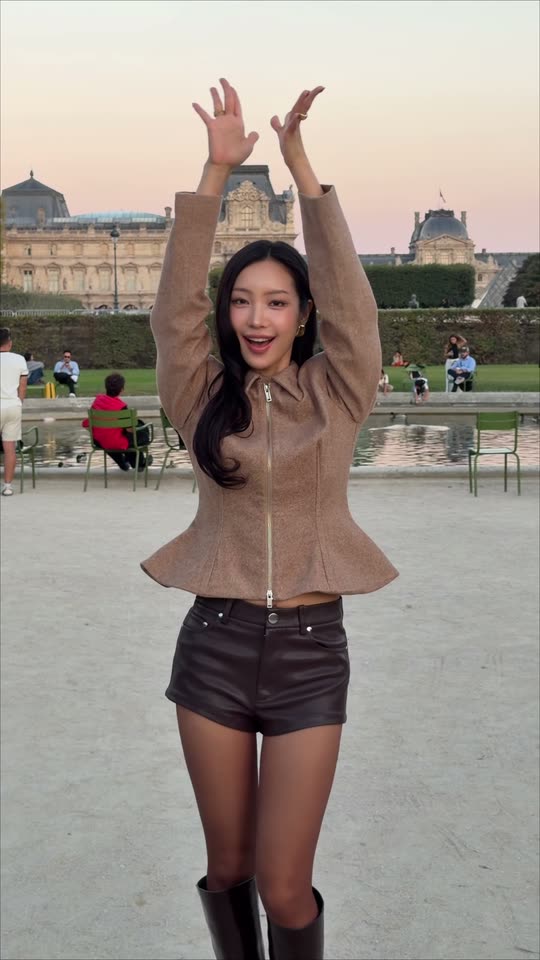
Four settings, four distinct fashion beats
The garden opening gives the first look time to establish itself. A hand on the hip, open arms and raised wrists make simple choreography readable without distracting from the outfit. The next city-night cut changes both lighting and silhouette, using smaller hand gestures against a landmark view.
At the Metro entrance, a small kick, pocket gesture and point toward the camera provide another variation. The final courtyard look becomes more fluid, with a sway, raised arm, turn and walk-away finish. The scene progression is as important as the dance: the viewer should understand that a new location introduces a new look.
The intended styling includes a structured jacket-and-shorts look, a long dark outer layer, a casual suede-and-knit interpretation and a dressier evening finish. Generated cuts may change garment details, text on signs or architectural elements. Review continuity of face and hair rather than expecting a perfect reproduction of every fashion item.
Both current choices are 26 seconds, vertical 9:16, and list 480p in the present catalog. Standard costs 181 credits and the HD-labeled choice costs 403. Those are the currently displayed specifications, not a promise that the higher label guarantees 720p. The configured reference soundtrack is saved with the final take.
Checking identity across fashion changes
A face that looks accurate in one scene can drift in another because distance, angle and light change. Review the sunset opening and darker closing view, not just a single attractive frame. A sharp full-body source photographed from a sensible distance gives both proportion and identity information.
The outfits should remain distinct across cuts. If a coat and dress blend or one location's styling follows into the next, the fashion story becomes less readable. Generated signs may also contain unusual lettering; a Metro-like setting is not proof of a faithful real-world station sign. The architecture and wardrobe are recreated as part of the AI scene.
Hair is another continuity cue. If it becomes closer to the reference creator's style, use a source that shows your own hair clearly for a future attempt. Watch the mouth against the soundtrack too: the audio is configured separately from the picture and exact syllable timing is not guaranteed.
A different take can vary, but repeated paid submissions are not a certain repair for every cut or garment. Choose a clear source first, then decide whether the overall four-look progression works as a fictional travel-fashion reel before sharing.
The music reference is Training Season by Dua Lipa, with the live-performance context used in the trend. Smew's configured soundtrack is joined to the completed visual result. That does not create an official artist connection or transfer rights to use the music in every advertisement, sponsored post or business account.
A caption can ask which look feels most like you, imagine the wardrobe for a future trip, or explain the contrast between everyday life and an elaborate Paris fashion itinerary. You do not need to copy a lyric or imply you really wore the generated looks at those locations. The aspirational mood can be playful while still being clearly fictional.
Keep an AI disclosure and the uploaded subject's consent. Descriptive fashion, city and song tags can help viewers understand the reference, but changing hashtag totals are not useful as reach promises. If you choose a licensed platform sound in a separate editor, check the terms and timing rather than assuming every version of the chorus is identical.
The same song appears in train-window and other dance templates, so compare the visual format when choosing. This page is the four-look outfit sequence; a shared soundtrack does not turn it into the phone-on-train scene or a general editor for your own travel clips.